Universal Design for Learning (UDL) is a teaching framework that helps teachers design lessons to meet learner variability from the outset, rather than adapting instruction only after students encounter barriers. In other words: UDL plans ahead for the spread of students in front of you before the lesson starts, instead of patching it up afterwards.
This article is for Year 7 to 12 teachers in Australia and New Zealand who are planning a unit and already know the class will not land in one place. You are not after another framework to add to the pile. You want to know what UDL actually asks of a lesson, how it differs from the differentiation you already do, and what it looks like in a real secondary classroom.
Key takeaways
- Differentiation responds to the class in front of you. UDL plans for it before you’ve even walked in. Both matter, but UDL asks you to look upstream.
- The three UDL principles (representation, action and expression, engagement) all point back to one thing: a clear, shared goal. What flexes is the path there, not the destination.
- UDL isn’t code for “give them endless choice” or “lower the bar.” A 2023 meta-analysis (King-Sears et al.) found a moderate positive effect for students taught with UDL compared with students taught the usual way.
- Planning for variability doesn’t mean building 30 different lessons. It means building enough flex into the one lesson that it can meet different starting points.
What is Universal Design for Learning?
If you’ve taught a secondary class, you already know “the class” rarely learns as one group. You explain something clearly, model it, check for understanding, set students off on the task, and still end up with one student ready to move on, another who hasn’t quite got the idea, and a third who’s understood it but can’t yet show you.
That’s not a failure of teaching. It’s what happens when you put a room full of different learners together, all working towards the same curriculum outcome without necessarily understanding, practising or showing that learning in the same way.
UDL starts from that as the normal state of a classroom, not something to fix once it shows up. Instead of teaching to an imagined “average” student and bolting on accommodations once someone struggles, you build the variability into the plan from the start. The question stops being how do you get this student to fit the lesson and becomes how do you design the lesson so it doesn’t put barriers in the way of the goal.
The idea goes back to David Rose and Anne Meyer’s 2002 book, Teaching Every Student in the Digital Age. CAST has kept building on it since: the current UDL Guidelines 3.0 (CAST, 2024) add the practical detail: how to set a goal that actually means something, how to pitch challenge and support, how to build fluency through practice, and how to grow a student’s ability to run their own learning.
Here’s the useful bit: when a student’s stuck, it’s not automatically a “them” problem. Sometimes the lesson’s doing it. One student gets the science but can’t show it in the format you’ve asked for. Another follows the demonstration fine but loses the thread the moment it’s a dense page of text. The struggle is real, but so is the possibility that the design of the lesson is what’s creating it.
How is UDL different from differentiation?
Simplest way to put it: differentiation responds. UDL plans ahead.
Differentiation is what you do once you’ve seen where students are landing: adjust the task, add scaffolding, dial the support up or down. UDL asks you to think about that earlier, before the lesson’s even been taught, so you’re not rebuilding it on the fly for the fourth time this term.
That doesn’t mean writing 30 different lessons. Nobody teaching five or six classes has time for that. It means building enough give into the one lesson that it can flex to meet different starting points without you starting from scratch every time. It’s a little more thinking before the lesson in exchange for a lot less rebuilding during the term.
Education Perfect puts this design idea simply: “Plan once, and reach everyone.” Map your content into adjacent curriculum levels and you can assign the right level of work without building several separate lessons from the ground up (Education Perfect).
What are the three principles of UDL?
Give students more than one way in, more than one way to show what they know, and keep them working towards the same goal.
Rose and Meyer built UDL around three moves, and CAST’s current guidelines have filled them out since:
- Multiple means of representation (the “what”): how students take in and make sense of information.
- Multiple means of action and expression (the “how”): how students show you what they know.
- Multiple means of engagement (the “why”): what keeps them at it.
1. Multiple means of representation (the “what”)
Best for: Concepts that click for some students when they are demonstrated or drawn, but stay stuck when they are only read or explained out loud.
Why it works: If the way a concept is presented is the barrier, the thinking never gets a chance to start. Offering the same idea in more than one form removes that barrier without changing what students are expected to learn.
Classroom example: In a Year 8 science class, a student who loses the thread halfway down a dense page on the water cycle may follow it straight away from a labelled diagram, then attach the vocabulary once the picture is in place.
Watch out for: Piling on formats without checking what each one is actually doing. More resources can overwhelm just as easily as they help. Always worth asking: is this actually removing a barrier, or just adding clutter?
Not every student takes in information the same way. Some concepts click faster demonstrated than read; an abstract idea can land the moment it’s drawn instead of described; a new topic might need the vocabulary taught explicitly before students can do anything with it on their own.
Worth having in the toolkit:
- Explaining it out loud
- Written text
- A diagram
- A worked example
- A demonstration
- A video
- A deliberate link back to something they already know
None of this is about piling on resources for the sake of it. It’s about checking whether the way you’re presenting something is itself the barrier.
2. Multiple means of action and expression (the “how”)
Best for: Tasks where the format students answer in might be testing something you never meant to test.
Why it works: When the goal is evaluating which argument holds up better, an essay format can end up measuring writing as well as reasoning. Letting students show their thinking in more than one form keeps the assessment on the thing you set out to assess.
Classroom example: In a Year 9 English class judging which of two arguments is stronger, some students write a paragraph, others record a short spoken response, and others complete a structured table. The success criteria are identical for all three.
Watch out for: Scaffolding that never comes off. The end point is a student who can do it without you standing there.
This is about what students actually do with the learning, and how they show it back to you. If the goal really is a persuasive essay, then writing is the point, fair enough. But if the goal is evaluating which argument holds up better, it’s worth asking whether the essay format is testing something you never meant to test. UDL isn’t about going easier on students. It’s about making sure you’re assessing the thing you actually set out to assess.
Worth building in: how much support a student needs isn’t fixed.
- A full worked example
- A partly completed example
- Just a prompt
- Nothing at all
That’s graduated support, and it’s part of this principle too. The end point isn’t permanent scaffolding. It’s a student who can do it without you standing there.
3. Multiple means of engagement (the “why”)
Best for: Classes where students switch on for different reasons and the work still has to stay worth doing.
Why it works: Engagement follows from the conditions you set up: a context that feels genuinely relevant, a real choice in how to tackle the task, and expectations that are clear from the outset.
Classroom example: In a Year 10 history class working towards “explain how the evidence supports your conclusion”, students choose which source set they work from, but every student is held to the same expectation and the same success criteria.
Watch out for: Turning every lesson into entertainment, or removing the productive struggle that comes with real learning.
Students don’t all switch on for the same reasons. UDL doesn’t mean turning every lesson into entertainment, and it definitely doesn’t mean removing the productive struggle that comes with real learning. It means setting up conditions where students can actually engage with work that’s worth doing.
Worth considering:
- A context that feels genuinely relevant, not bolted on
- A real choice in how students tackle the task
- Expectations that are clear from the outset
Why do clear goals matter more than choice in UDL?
Because flexibility only helps when everyone knows what they are working towards.
One of the easiest ways to get UDL wrong: reading it as “give students lots of options.” Without a genuinely clear goal, flexibility just turns into noise.
Compare “students will complete this task” with “students will explain how the evidence supports their conclusion.” The second one actually tells you what you’re teaching towards, and once that’s nailed down, it’s much easier to see which parts of the task are essential and which are just “the way it’s always been done.”
This is why UDL sits comfortably alongside explicit teaching, not against it. You can still explain something clearly, model it, run guided practice, and pull the scaffolding back as students get there. UDL doesn’t ask you to swap structure for endless choice. It asks you to build that structure with the variability already accounted for.
What does UDL look like in a real secondary classroom?
Camilla Andrews teaches maths out of the specialist support centre at Mountain Creek State High School, on Queensland’s Sunshine Coast. In one class, she might have students working anywhere from Year 2 level through to Year 9 level, several of them on Individual Curriculum Plans.
“Differentiation isn’t optional, it’s essential,” is how she puts it. With a spread that wide, she needs to know exactly where each student sits and what they need next, not a rough class average. She tracks it against curriculum content descriptors rather than raw scores, which is why she can say: “It’s just so quick and easy to see where each student is at and what they need next” (Education Perfect, 2025a).
That’s UDL doing its job in one real classroom. The goal for each content area doesn’t move. What moves is the starting point, the level of the task, and what happens next, and all of that gets sorted before the lesson runs, not after a student’s already hit the wall.
How does assessment fit into UDL?
Assessment is part of the design. It’s also the thing that happens after the teaching’s done. If a task meant to check conceptual understanding is actually testing reading fluency or how well a student can decode fiddly instructions, the result won’t tell you what you need to know.
Think of it as one loop rather than three separate jobs: instruction builds the knowledge, practice lets students use it, and assessment tells you whether someone needs another go at it, more practice, or a harder problem. Education Perfect frames its own version of this as “instruction, practice and assessment in one continuous loop — where every phase informs the next, and progress is visible at every step” (Education Perfect).
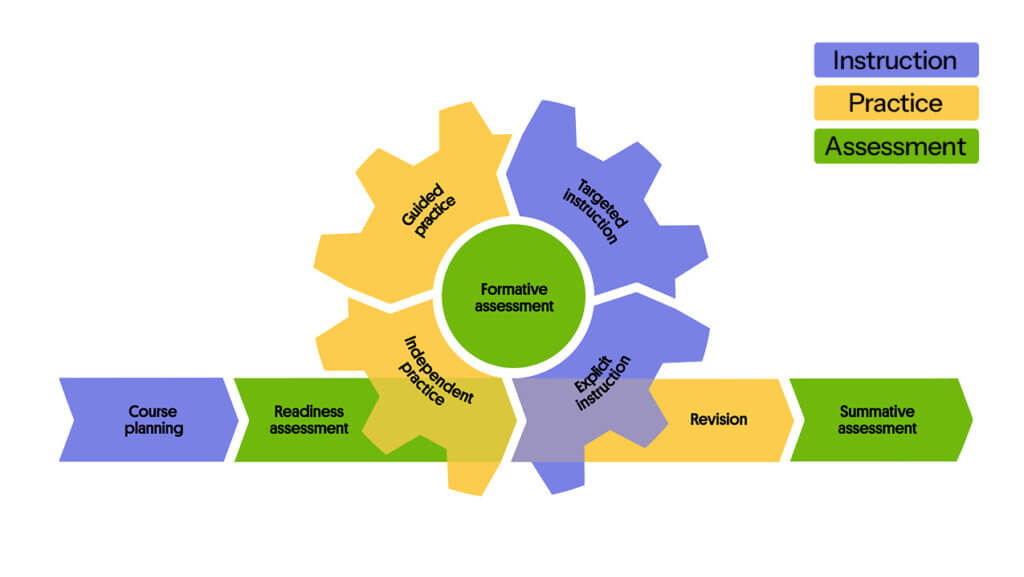
It’s not teach, test, move on. It’s teach, practise, check, respond, practise again. That gap matters most exactly when students are starting from different places, because the “respond” step doesn’t have to look the same for everyone.
A platform can make that evidence easier to see, but it doesn’t make the calls for you. Education Perfect says as much itself: “teachers lie at the heart of all teaching and learning experiences,” and the platform is built to “augment and support the teacher”, not replace them. You’re still the one deciding what needs to be taught, how it should be scaffolded, and what comes next. The tech just makes that decision easier to make well.
What’s UDL actually building towards?
None of this is only about getting through today’s lesson. CAST frames the wider goal as learner agency: students who get more purposeful, reflective and strategic about their own learning over time, not students who stay dependent on the same level of support forever.
That’s part of why graduated support matters. A student leaning on a worked example in Term 1 shouldn’t need the same scaffold in Term 3. The aim is a student who can recognise what they know, spot what they still need, and choose their own next move, rather than one who’s permanently propped up.
It’s worth knowing that Education Perfect ties its own platform design directly to this goal. The whitepaper behind its Learning Cycle states that the platform has been “intentionally designed to support learner agency, in line with the goals of the UDL framework” (Education Perfect, 2025b).
What common mistakes do teachers make with UDL?
- Reading UDL as “unlimited choice.” Skip the clear goal and flexibility just turns into noise, not purpose.
- Assuming every student needs a different task. With 30 in the room, that’s not realistic and it’s not the point. UDL is one design with enough give in it, not 30 separate lesson plans.
- Fixing it after the fact instead of before. Adding support once a student’s already struggled is differentiation, useful, but not UDL. UDL’s whole value is catching the barrier before the lesson runs.
FAQ
What does UDL stand for?
UDL stands for Universal Design for Learning. It is a teaching framework for designing learning experiences that anticipate learner variability and reduce barriers to learning from the outset. It means planning your lesson so it works for the range of students actually in front of you, rather than an imagined average one.
What are the three principles of UDL?
UDL has three principles: multiple means of representation (how students take in information), multiple means of action and expression (how they show what they know), and multiple means of engagement (what keeps them working). All three point back to one clear, shared goal, and what flexes is the path to it, not the destination.
How is UDL different from differentiated instruction?
Differentiation is what you adjust once you can see where students are landing. UDL is designing for that spread before the lesson happens, so you’re heading off the barriers rather than patching them afterwards. Use both: they’re not in competition.
Does UDL mean going easier on some students?
No. UDL keeps the goal exactly as ambitious for everyone. What changes is the path to it: how they take in information, how they show what they know, what keeps them engaged. Not how hard the thinking has to be.
Is UDL just for students with additional learning needs?
No. Every classroom has variability, not just the ones with formally identified needs, so UDL is a whole-class approach. Design a lesson with UDL in mind and the whole class tends to benefit, including students who’d never have been flagged for extra support.
Do I need new resources or training to start using UDL?
Not really. It’s more a way of thinking about a lesson than a set of new materials. If you’re already using worked examples, offering a text in more than one format, or giving students options in how they show their understanding, you’re already doing some of this.
Does UDL actually make a difference to results?
A 2023 meta-analysis (King-Sears et al.) compared students taught with UDL against students taught the usual way and found a moderate positive effect in favour of UDL. That is an average across many studies, so it does not guarantee the same result in any single classroom. Treat it as a reason to try UDL thoughtfully, not a promise.
Related articles
- Teaching pedagogy guide (pillar)
- Differentiated instruction for mixed-ability classes
- Explicit instruction
- Formative vs summative assessment
References
- CAST (2024). Universal Design for Learning Guidelines (version 3.0). udlguidelines.cast.org
- Education Perfect. Homepage, “Personalise learning at scale.” educationperfect.com
- Education Perfect. Our Impact, “The EP Learning Cycle.” educationperfect.com/impact
- Education Perfect (2024). EP Learning Cycle [Diagram]. Internal asset.
- Education Perfect (2025a). Learning Snapshots: Smart Simplicity [Case study, Mountain Creek State High School]. educationperfect.com/case-study/mountain-creek-state-high-school
- Education Perfect (2025b). EP Learning Cycle: The Evidence Base [Whitepaper], pp. 3-4. Download PDF
- King-Sears, M. E., Stefanidis, A., Evmenova, A. S., Rao, K., Mergen, R. L., Owen, L. S., & Strimel, M. M. (2023). Achievement of learners receiving UDL instruction: A meta-analysis. Teaching and Teacher Education, 122, 103956. doi.org/10.1016/j.tate.2022.103956
- Rose, D. H., & Meyer, A. (2002). Teaching Every Student in the Digital Age: Universal Design for Learning. ASCD.
- Rose, D. H., & Meyer, A. (2006). A Practical Reader in Universal Design for Learning. Harvard Education Press.
Rachel Ellis, MA Applied Linguistics. Last updated: 1 October, 2026.