Bloom’s Taxonomy in the classroom: a practical guide with verbs and question stems
Bloom’s Taxonomy is a six-level framework — Remember, Understand, Apply, Analyse, Evaluate, Create — that helps teachers design lessons, questions, and tasks at the right level of thinking. Each level builds on the one before it, so students develop genuine understanding rather than surface recall. The associated verbs and question stems make each level practical to use in any classroom.
You’ve probably seen the pyramid. What may be less familiar is what it looks like in an actual lesson — when a Year 9 student moves from the bottom to the top in a single sitting. That’s what this article is for.
Key takeaways
- Bloom’s Taxonomy has six levels: Remember, Understand, Apply, Analyse, Evaluate, Create.
- Each level has associated verbs that make learning objectives concrete and measurable.
- EP lessons are built around Bloom’s — the taxonomy shapes section headings, question types, cognitive verbs, and mastery thresholds.
- Questions are the primary tool for checking whether a student has genuinely mastered a level, or just passed through it.
- Learning is cumulative: students cannot reliably analyse what they haven’t yet understood.
What is Bloom’s Taxonomy?
Bloom’s Taxonomy is a six-level framework for classifying learning objectives, from basic recall through to original thinking at the top. Developed by educational psychologist Benjamin Bloom in 1956 and revised in 2001 by Anderson and Krathwohl, it gives teachers a shared language for designing questions, tasks, and assessments at the right level of thinking for their students.

Bloom’s Taxonomy at a glance
| Level | Thinking skill | Useful verbs |
|---|---|---|
| 1 Remember | Recall information | define, list, identify, name, recall, match |
| 2 Understand | Explain meaning | explain, describe, compare, summarise, predict |
| 3 Apply | Use knowledge in a new context | solve, demonstrate, classify, calculate, modify |
| 4 Analyse | Examine relationships and patterns | analyse, differentiate, investigate, deduce, contrast |
| 5 Evaluate | Make a reasoned judgement | assess, justify, critique, defend, decide |
| 6 Create | Produce something original | design, formulate, develop, compose, hypothesise |
Why does the order matter?
The levels are not arbitrary. As the revised taxonomy by Anderson and Krathwohl (2001) explains, each level depends on the one below it. A student cannot apply knowledge they haven’t understood, and they cannot evaluate an argument they haven’t learned to analyse.
This is why EP lessons are “carefully scaffolded, chunked and paced to allow all students the opportunity to experience success” with instructional material interwoven with questioning throughout, and students given instant feedback before moving on. Questions move from “simple recall and comprehension of newly presented material through to scaffolded practice and extensive independent practice,” with each stage building on the last.
Picture a Year 10 Science class studying chemical reactions. A well-sequenced lesson doesn’t open with “design an experiment.” It opens with “what are the products of this reaction?”, then builds.
How does EP use Bloom’s Taxonomy?
Bloom’s Taxonomy isn’t a reference point for EP — it’s built into how lessons are made.
EP’s Learning Cycle whitepaper (Drury, 2026) states that Bloom’s taxonomy, as revised by Anderson and Krathwohl (2001), “guides the general sequencing of EP lessons. Students work through activities that ask them to remember and understand, move on to application and analysis activities, and conclude with tasks that challenge their evaluative thinking and creative skills.”
That decision has a history. Shane Smith, one of EP’s founders, describes the shift directly: “We were catering incredibly well to one of the levels of Bloom’s Taxonomy. But teachers were trying to teach the whole taxonomy. And so to support them… we needed to build a platform that genuinely was able to map these different shapes.” The result was lessons built around the full six-level sequence — scaffolded information before questioning, explicit separation between learning and assessment, and adaptive pathways that tie assessment data back to which lessons each student needs next.
The 2001 revised version, which reframed the six levels as action verbs rather than nouns, is the version EP works from, because “analyse” tells you more than “learn about.”
In practice, this means three things.
Section headings use Bloom’s language directly. The screenshot below shows the EP States of Matter lesson in progress. The left-hand navigation panel labels sections as “Remembering: Changing States” and “Applying: Changing States.” The taxonomy is visible before students begin a single question.
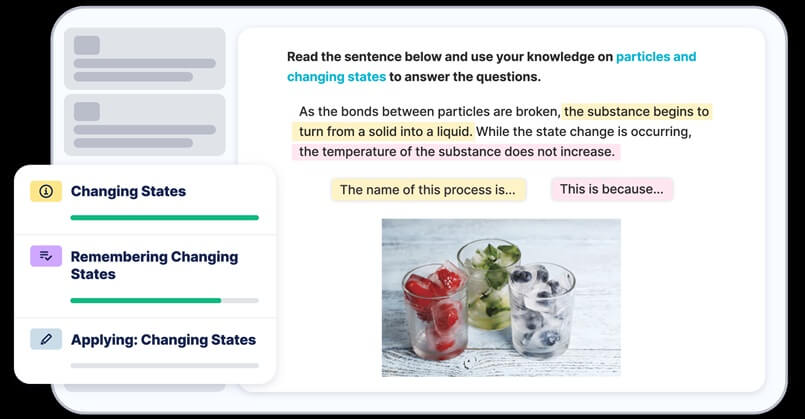
Cognitive verbs are embedded into question prompts. The QCAA cognitive verbs list — define, identify, explain, analyse, evaluate, justify, compose — maps directly onto Bloom’s levels and appears throughout EP lesson scripts and question banks. A question that asks students to account for the perspective of a historical source isn’t using that phrase by accident; account for sits at the Analyse level.
Mastery is required before progression. Bloom (1968) argued that “most students (perhaps over 90 per cent) can master what we teach“. The goal is finding the methods and materials to help the largest proportion of students reach it. EP puts this into practice: “completing an EP lesson requires a student to eventually answer every question correctly.” Students can’t skip ahead. Get a question wrong, and the lesson gives feedback, shows a model answer, and tries a different version of the question until you get it right, then moves on. The taxonomy isn’t just labelling what’s happening. It’s determining what happens next.
What are the six levels, and what do they look like in practice?
Level 1 — Remember: Can they recall it?
definelistlabelrecallnameidentifystatematchrecognise
Question stems
- What is…?
- Can you name the…?
- How would you define…?
- List the steps for…
This is the foundation. Students retrieve information they’ve been taught: nothing more, nothing less. It’s the entry point to every new topic, and it’s not something to rush past. Students who can’t recall the basics can’t build on them.
EP example — Science: States of Matter
The screenshot above shows this in action. The “Remembering: Changing States” section presents a passage about particles and bonds, then prompts students: “The name of this process is…”: a pure recall task. The section is complete (shown by the full green bar in the nav panel) before students are allowed to move into “Applying: Changing States.”
Level 2 — Understand: Can they explain it?
explainsummarisedescribeinterpretcompareparaphraseoutlinepredict
Question stems
- Can you write this in your own words?
- What was the main idea?
- What do you think could happen next?
- Can you distinguish between X and Y?
Understanding is demonstrated when a student can go beyond reciting a fact — when they can put it in their own words or anticipate consequences. “True or false” questions sit at Level 1; “explain why” sits at Level 2.
EP example — Senior English: Narrative Voice in Poetry
An EP lesson on narrative voice opens by defining the three narrative points of view — first, second, and third person — then asks students to identify which perspective is operating in a given poem extract. Early questions use define and match (Level 1). The questions then shift to two extracts from Coleridge’s The Rime of the Ancient Mariner — students identify which narrative voice is operating in each: the anonymous third-person narrator, or the mariner speaking in first person. To get it right, students have to look past the surface of the text and read for pronouns and perspective. The lesson’s creative task goes further still, asking students to rewrite a passage in first person and explain the effect that shift creates on the reader — that’s where the move from remembering to understanding becomes visible.
A student who can only recall the three perspectives hasn’t understood them. The explain step is what shows whether the concept has actually landed.
Level 3 — Apply: Can they use it?
applysolvedemonstrateconstructcalculateclassifymodifyillustrate
Question stems
- Do you know another instance where this works?
- How would you use this in a different situation?
- Can you apply this method to your own experience?
- What would you change if the conditions were different?
Application is where knowledge stops being abstract. Students take what they’ve understood and use it in a new context.
EP example — Year 9 Maths: Mixed Numbers and Improper Fractions
An EP Year 9 lesson on converting and comparing mixed numbers and improper fractions shows Apply in action through its Stepping Up practice questions. After working through the conversion method — multiply the whole number by the denominator, add the numerator, write the result over the denominator — students aren’t just asked to repeat the same type of sum. One question asks them to convert 26/12 to a simplified mixed number (26 ÷ 12 = 2 remainder 2, giving 2 2/12, simplified to 2⅙). Another asks them to order 17/8, 5/4, and 1½ from least to greatest, which requires converting all three to a common denominator before comparing. The method is the same; the contexts keep shifting.
If a student can only reproduce the worked example they were shown, they’ve memorised a procedure, not understood one, and the next unfamiliar context will expose it.
Level 4 — Analyse: Can they break it apart?
analysecomparedifferentiateexaminecategoriseinvestigatededucecontrast
Question stems
- How was this similar to or different from…?
- What was the underlying theme?
- What assumptions are being made?
- Can you distinguish between the motives for…?
Analysis asks students to look inside something; to examine its structure, find patterns, and understand how the parts relate to the whole. This is where critical thinking begins in earnest.
EP example — HSC Modern History: Source Analysis
An EP HSC Modern History question set on Nazi Germany asks students to account for the perspective of the writer in a primary source: a private letter from a German woman in 1933, written during the Nazi boycott of Jewish businesses. Students cannot simply identify her view. The task demands they explain why that perspective exists: drawing on the antisemitism long present in German society, the scapegoating that blamed Jews for Germany’s post-war humiliation, and the “Hitler myth”: the widespread belief that the Führer knew what was necessary for Germany, even when his actions were difficult to witness. That is Level 4 work: not “what does this source say?” but “what historical forces produced this view, and how do they connect?” The verb is account for, an explicit Analyse-level cognitive verb in the QCAA framework.
Level 5 — Evaluate: Can they judge it?
evaluatejustifyargueassesscritiquerecommenddefenddecide
Question stems
- Is there a better solution?
- Can you defend your position?
- What criteria would you use to judge…?
- How effective is this approach?
Evaluating means forming and defending a view. Students aren’t just describing or analysing, they’re making a case.
EP example — Year 9 Maths: Mixed Numbers and Improper Fractions
One Stretch question in the Year 9 Mixed Numbers and Improper Fractions lesson asks: “A student says: ‘If you have two mixed numbers, the one with the larger whole number is always greater.’ Decide whether this statement is always, sometimes, or never true. Justify your answer with two examples.” Students have to evaluate a claim — test it, find the edge case (when both whole numbers are equal, and the fractional parts determine the order), and make a reasoned judgement. That’s Level 5.
Level 6 — Create: Can they make something new?
createdesigncomposeformulateplanconstructdevelophypothesise
Question stems
- Can you design a… to…?
- What would happen if you changed…?
- Can you develop a proposal for…?
- What alternative would you suggest?
Creation is not “make it pretty.” It’s producing something original — a plan, a piece of writing, an experiment design, an argument — that draws on everything learned at the levels below.
EP example — Senior English: Narrative Voice in Poetry (extended response)
The final extended task in the narrative voice lesson asks students to imagine they are writing a narrative poem about a real-world issue. They must describe the issue and their purpose (50–100 words), then describe the narrative voice they would create and explain their reasons for that choice. To do this well, students have to draw on everything from the lesson: their understanding of first, second, and third person; their analysis of how Coleridge and Mew used voice to shape meaning; and their evaluation of whose voices get heard in poetry and why. The task doesn’t have a single correct answer. It asks students to generate something original, informed by everything that came before it. That’s Level 6.
How does this look as a full lesson sequence?
The States of Matter lesson is a good illustration of how the levels sequence through a single topic, and how EP makes that sequence visible. The left-hand navigation panel tells you the cognitive arc at a glance: recall first, then application. Students work through each section completely before the next unlocks.
That’s not just a structural convenience. It reflects how Bloom argued learning actually works: each level is only accessible once the level beneath it is secure. EP builds this into the platform so the sequencing happens by design, not by chance.
The same logic applies to any well-sequenced lesson. The questions at the start of a topic are different in kind from the questions at the end — not just harder, but requiring a different type of thinking.
What’s the most common mistake when using Bloom’s?
Treating it as a grading tool rather than a design tool. Bloom’s works best when it shapes what you ask, not just how you mark. A lesson built around Level 1 and 2 questions only, even good ones, is unlikely to build the deeper thinking students need.
The second common error is using high-level verbs for low-level tasks. Asking students to “analyse” a text when the task only requires them to summarise it doesn’t move their thinking forward, it just uses a more impressive-sounding word.
FAQs
What is Bloom’s Taxonomy in simple terms?
Bloom’s Taxonomy is a six-level framework — Remember, Understand, Apply, Analyse, Evaluate, Create — that helps teachers design questions and tasks at the right level of thinking. Each level builds on the one before it, so students develop genuine understanding rather than surface recall.
What are the six levels of Bloom’s Taxonomy?
Remember (recall), Understand (explain), Apply (use in a new context), Analyse (break apart and examine), Evaluate (judge with evidence), Create (produce something original). The 2001 revised version, by Anderson and Krathwohl, uses verbs rather than nouns, making the levels easier to apply in lesson planning.
What verbs go with each level of Bloom’s Taxonomy?
Each level has associated action verbs: Remember — define, list, recall; Understand — explain, summarise, compare; Apply — solve, demonstrate, classify; Analyse — examine, differentiate, investigate; Evaluate — justify, assess, critique; Create — design, compose, formulate.
How do you use Bloom’s Taxonomy in a lesson?
Start a unit with Level 1 and 2 questions to build the foundation. Move into Level 3 and 4 as understanding develops. Reserve Level 5 and 6 tasks for the end of a unit, when students have enough knowledge to form and defend an original view or produce something new.
Do students have to complete every level in every lesson?
Not necessarily. A single lesson might only target two or three levels. What matters is that over a unit, students are taken all the way up the pyramid — not left at recall and comprehension alone.
How does EP use Bloom’s Taxonomy?
According to EP’s Learning Cycle whitepaper (Drury, 2026), Bloom’s taxonomy guides the general sequencing of EP lessons — from recall and comprehension through to evaluative thinking and creative tasks. Section headings use Bloom’s language directly, cognitive verbs are embedded into question prompts, and students must answer every question correctly before progressing to the next level.
Related articles
References
Anderson, L.W. and Krathwohl, D.R. (2001). A Taxonomy for Learning, Teaching, and Assessing: A Revision of Bloom’s Taxonomy of Educational Objectives. Addison Wesley Longman.
Bloom, B.S. (Ed.) (1956). Taxonomy of Educational Objectives: The Classification of Educational Goals. Longmans, Green & Co.
Drury, A. (2026). Education Perfect’s Learning Cycle: The evidence base. Education Perfect. Available via the EP Impact Hub.
Education Perfect Help Centre (n.d.). How does EP support different pedagogical approaches? help.educationperfect.com
Landmark Outreach (n.d.). Revised Bloom’s Taxonomy — Verbs, Sample Question Stems, Potential Activities and Products. landmarkoutreach.org
Smith, S. (2026). Interview. Well Measured, Episode 2. Education Perfect. Available via the EP Impact Hub.
Last updated: September 2026 · Author: Rachel Ellis, MA Applied Linguistics